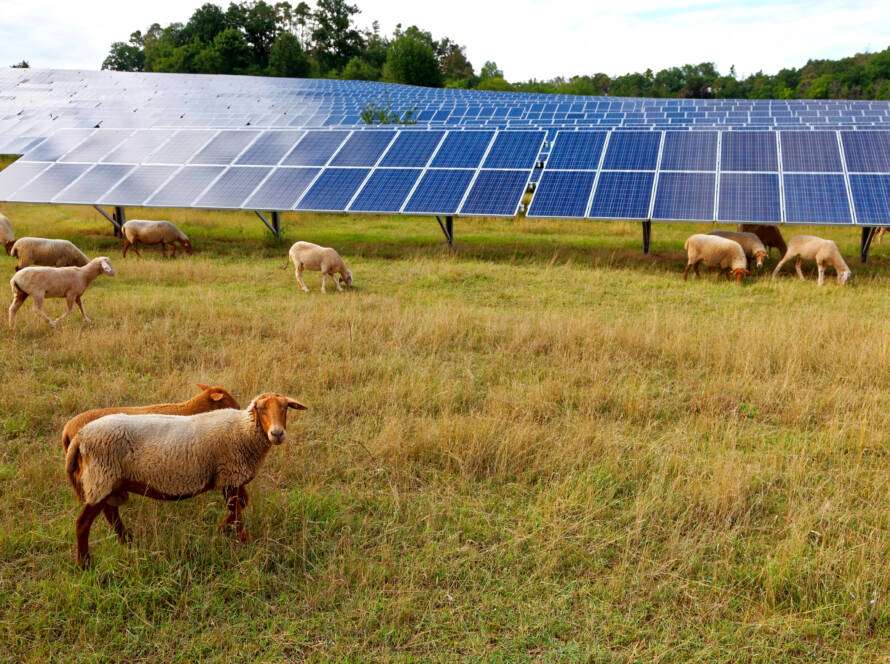
Agrivoltaics is increasingly developing from an innovation project into a serious building block of modern agriculture. Rising energy prices, pressure on agricultural yields and political support for renewable energy are leading more and more farms, investors and municipalities to examine agrivoltaic projects.
Technical feasibility is usually not the real problem. Modern tracker systems, larger row spacing and highly elevated structures now allow largely normal agricultural use between the modules. What is decisive is whether a project can be permitted.
Because that is exactly where many projects fail: not because of the technology, but because of urban land-use planning, regional planning, nature conservation, agricultural law, a lack of municipal support or an expensive grid connection.
Anyone who wants to develop an agrivoltaic system in the outer zone (Außenbereich, i.e. land outside built-up areas) today therefore has to think strategically much earlier than with conventional ground-mounted systems. In particular, Section 35 BauGB, DIN SPEC 91434 and municipal land-use planning determine whether a project can be approved within a few months, or remains blocked for years.
This guide shows which permitting routes are currently considered particularly robust and what farmers, investors and municipalities actually need to look out for in practice.
When agrivoltaics can be privileged in the outer zone
The most important legal basis for agrivoltaics in the outer zone is Section 35 of the Federal Building Code (BauGB). Since the legislative amendment in 2023, certain agrivoltaic systems have been privileged under defined conditions. This considerably improves the starting position, especially for farms.
In practice this means that, for certain agrivoltaic projects, a full land-use planning procedure with a development plan can be dispensed with. Nevertheless, a misunderstanding often arises: privileged does not mean exempt from permits.
Privileged installations must still be compatible with public interests. These include, among others:
- regional planning,
- nature conservation,
- protection of historic monuments,
- water law,
- emission control
- and agricultural requirements.
The authorities therefore continue to check very carefully whether the main agricultural use is actually maintained, or whether a conventional ground-mounted system is in fact being built.
It is precisely at this point that successful projects differ from problematic ones. Municipalities and agricultural authorities are reacting increasingly sensitively to projects that formally present themselves as agrivoltaics but in practice hardly allow any agricultural use.
The requirements for privileged construction under Section 35 BauGB
For an agrivoltaic system in the outer zone to be permissible as a privileged project, several requirements currently have to be met at the same time.
Of particular importance is the so-called spatial-functional connection. The system must serve an existing farm and have a traceable link to the farmstead. Pure investor projects without genuine agricultural integration regularly do not meet this requirement.
In addition, the current legal situation provides for an area limit. Privileged agrivoltaics is generally designed for a maximum of 2.5 hectares. At the same time, only one privileged installation per farmstead or farm site is currently provided for.
In practice, many false assumptions arise exactly here. Many project developers assume that the privilege automatically enables fast approval. In fact, districts now examine much more closely:
- how intensively the land continues to be farmed,
- which machines are used,
- how high the actual yield losses are,
- and whether farming remains economically viable in the long term.
Systems are assessed particularly critically where:
- tramlines are too narrow,
- large farm machinery can no longer work,
- shading permanently reduces yields,
- or the land is used predominantly for energy rather than agriculture.
As a result, the technical design is becoming increasingly important. Many authorities view modern tracker systems with larger row spacing much more positively than densely built standard ground-mounted systems.
When a development plan becomes necessary
As soon as the requirements for the privilege are no longer met, permitting becomes considerably more complex.
This applies in particular to:
- larger agrivoltaic projects,
- institutional investor models,
- municipal energy parks
- or projects without a sufficient link to a farmstead.
In these cases, an ordinary building application is usually no longer sufficient. Instead, the municipality first has to create its own building rights. This is exactly where the classic urban land-use planning procedure begins.
For many project developers, this is the real key phase of the entire project. Because here it is not the technical planning that determines success or failure, but political and municipal acceptance.
Municipalities today ask questions such as these much more often:
- What benefits does the region gain?
- Will agriculture really be maintained?
- How visible will the system be?
- Is there opposition from the population?
- What trade tax effects will arise?
- How likely is a grid connection?
Anyone who can answer these questions early significantly improves the chances of success.
The typical permitting route for larger agrivoltaic projects
For larger agrivoltaic systems, the land-use plan (Flächennutzungsplan) is usually amended first. Many outer-zone sites are still shown there exclusively as agricultural land. If an agrivoltaic system is to be built, the municipality often has to designate the land as a special area for renewable energy or agrivoltaics.
In parallel, a project-related development plan under Section 12 BauGB is usually drawn up. This instrument has become established in practice because it gives the municipality planning certainty, while the project developer bears the costs of planning.
The development plan then lays down numerous technical and ecological conditions in binding form. These include, for example:
- height of the system,
- row spacing,
- screening with vegetation,
- species protection,
- glare,
- compensation measures
- and decommissioning obligations.
Binding building rights only arise once the bylaw has been adopted. As a rule, the actual building application follows afterwards.
In practice, this overall process often takes between 18 and 24 months. The procedures are most often delayed considerably by:
- unresolved grid connections,
- political discussions,
- species protection conflicts
- or incomplete documentation.
Why DIN SPEC 91434 is decisive today
DIN SPEC 91434 plays a central role in the long-term economic viability of an agrivoltaic project. It defines the key requirements for when a system can actually be classified as agrivoltaics.
This concerns in particular:
- the main agricultural use,
- land take,
- and long-term yield capacity.
The authorities are increasingly paying attention to whether agriculture not only continues formally but can still be practised sensibly in practice.
A key point is the agricultural reference yield. The DIN SPEC requires the land to retain a substantial part of its original agricultural yield permanently. At the same time, the actual loss of land through foundations, transformer stations or technical infrastructure is also limited.
That is precisely why it is usually no longer enough today simply to place solar modules on agricultural land. Successful projects need a robust agricultural use concept that realistically takes into account:
- cultivation,
- machinery concepts,
- crop types,
- yield development
- and operating processes.
Many authorities now require much more detailed evidence than just a few years ago.
Why modern tracker systems can improve permit prospects
Practice increasingly shows that the technical design has a direct influence on whether a project can be permitted.
Conventional, densely built ground-mounted concepts often meet with scepticism from agricultural authorities. The reason: large machines can only work to a limited extent, cultivation axes are interrupted and the actual agricultural use loses credibility.
Modern tracker systems (in German) solve many of these problems much better. Thanks to larger row spacing and movable module positions, the following are preserved much better:
- wheel tracks,
- working widths
- and light conditions.
Especially for large-scale arable farming or special crops, this often considerably improves acceptance by authorities and municipalities.
There are also strategic advantages in the permitting process. Projects look less like conventional solar parks and more like genuine combined agriculture and energy projects. This perception is becoming increasingly important in municipal procedures.
The most common mistakes in agrivoltaics permitting
Many projects fail not because of individual expert reports, but because of strategic mistakes in the early phase.
Particularly problematic are:
- talking to the municipality too late,
- unrealistic grid connection assumptions,
- a lack of coordination with agricultural authorities,
- overly aggressive use of the land
- or weak use concepts.
Another common mistake is to view the permitting process purely technically. In fact, agrivoltaic projects are always political projects too.
Municipalities want to be able to understand:
- what regional benefit a project has,
- how agriculture is safeguarded,
- and whether long-term acceptance among the population will develop.
Anyone who takes these factors into account early reduces project risk considerably.
Conclusion: permitting certainty becomes the decisive success factor
Agrivoltaics is increasingly developing into a market segment of its own between agriculture, infrastructure and energy supply. At the same time, regulatory requirements are rising noticeably.
While smaller privileged systems can be realised comparatively quickly under certain conditions, larger projects today require a professionally managed interplay of:
- urban land-use planning,
- agriculture,
- nature conservation,
- grid infrastructure
- and municipal coordination.
The real challenge therefore lies not only in the technology but in strategic project development.
Anyone who:
- involves the authorities early,
- takes the requirements of DIN SPEC 91434 seriously,
- develops robust agricultural concepts
- and understands the municipal perspective
significantly improves the chances of a successful agrivoltaics permit.
Gain legal certainty for your agrivoltaic project
Whether it is a privileged farm installation under Section 35 BauGB or a large-scale land-use planning procedure: the Ylektra team supports farmers, investors and municipalities from the first site analysis through permitting strategy to realisation.
A non-binding initial assessment can examine, among other things:
- permit prospects,
- proximity to a grid connection,
- options for privileged status,
- the municipal framework
- and the technical suitability of the land for modern agrivoltaic systems.
FAQ: permitting agrivoltaics in the outer zone
Is agrivoltaics generally permitted in the outer zone?
Agrivoltaics can generally be permitted in the outer zone if the requirements of Section 35 BauGB are met. What matters in particular is that the project is either privileged or secured in planning law through a land-use planning procedure. Even for privileged projects, the review of public interests remains mandatory.
When is an agrivoltaic system considered privileged?
Privileged status may apply if there is a spatial-functional connection to a farm, the system as a rule does not exceed a certain size, and the main agricultural use continues to take precedence. Pure investor projects without agricultural integration generally do not fall under this privilege.
Does every agrivoltaic system need a development plan?
No. A development plan is required in particular if there is no privilege or if larger projects are to be implemented outside the typical conditions. In these cases, the municipality first creates building rights under planning law, usually through a project-related development plan.
How long does an agrivoltaics permit take in practice?
The duration depends heavily on project size, location and municipal coordination. Privileged projects can be decided within a few months, while projects requiring land-use planning often take around 18 to 24 months. Delays are often caused by grid connection issues, environmental assessments or political coordination.
What role does DIN SPEC 91434 play?
DIN SPEC 91434 defines key requirements for agrivoltaics, in particular to ensure the main agricultural use. In practice, it is an important assessment benchmark for authorities and also plays a significant role in classification under the EEG and in long-term recognition as an agrivoltaic system.
Which sites are particularly suitable for agrivoltaics?
Particularly suitable are sites with existing agricultural use, sufficient access, proximity to the grid connection point and little conflict with protected areas. In addition, a clear agricultural cultivation perspective considerably improves the chances of a permit.
Why do agrivoltaic projects most often fail?
The most common reasons are not technical but planning-related and strategic. These include, in particular, a lack of municipal support, unresolved grid connections, inadequate agricultural use concepts and conflicts with environmental and regional planning.
How important is the grid connection for the permit?
In practice, the grid connection is often a limiting factor. Even if a building permit is possible, projects without secured grid capacity cannot be implemented economically or on schedule. The grid connection is therefore increasingly integrated into project development at an early stage.