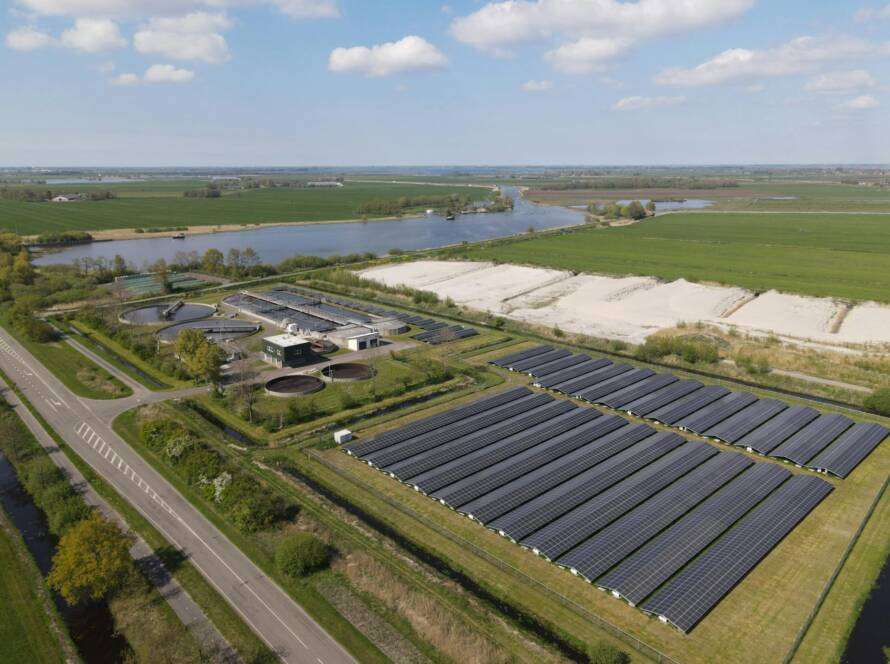
The expansion of renewable energy in Germany is accelerating – and competition for available land is intensifying. While conventional solar farms use open land exclusively for power generation, agrivoltaic systems go one step further: they combine photovoltaics with active farming.
This dual use of land is regarded as a key technology for reconciling climate protection, food security and economic interests. According to a study by the Fraunhofer Institute for Solar Energy Systems (ISE), Germany has the potential for up to 500 gigawatts of agrivoltaics – enough to accelerate the energy transition significantly and ease land-use conflicts.
But how do agrivoltaic systems compare with conventional solar farms? This article looks at the benefits, drawbacks, costs and returns of agrivoltaics compared with ground-mounted solar.
What is agrivoltaics – and how does it differ from a conventional solar farm?
Agrivoltaics (Agri-PV) means installing solar modules so that the land beneath them or between the module rows can continue to be farmed – for example with elevated, vertical or tracking systems.
Conventional solar farms (ground-mounted PV), by contrast, rely on low-mounted, mostly south-facing modules that deliver maximum power output per area – but without agricultural use.
System designs compared
Agrivoltaic systems
- Trackers (single-axis tracking systems) with bifacial modules for maximum efficiency with minimal land take
- With Ylektra’s agrivoltaics concept, around 85 % of the land remains effectively usable for farming
- Module rows are adapted to the individual agricultural concept for each site
- Compliant with the German standard DIN SPEC 91434
- Over 80 % approval in surveys – compared with 67 % for conventional solar farms
Ylektra advantage: We combine agrivoltaics with utility-scale battery energy storage (BESS) to store energy efficiently and feed it into the grid – a clear competitive advantage for investors and landowners.
Conventional solar farms
- Dense module layout, up to 2 MW per hectare
- Complete change of land use and sealing
- Greater potential for conflict in nature conservation areas and with public acceptance
Costs and returns of agrivoltaics
Agrivoltaics requires a higher initial investment but offers attractive long-term returns through additional income and increasing support.
Cost comparison:
- Agrivoltaics: investment of €600,000–900,000 per hectare
- Conventional solar farms: investment of €400,000–600,000 per hectare
- Electricity revenue only, no agricultural income
- Project return: 5–8 %
Sustainability and environmental protection
Environmental benefits of agrivoltaics:
- 20–30 % lower water consumption thanks to shading
- Protection against soil erosion
- Biodiversity promoted through flowering strips
- Fully removable without sealing the land
Conventional solar farms
- Already more than 45,000 hectares of farmland used in Germany
- Risk to biodiversity from large monoculture areas
Trends: hybrid solutions and local value creation
The next stage of the energy transition will not be shaped by photovoltaics alone, but by intelligent combinations of technologies. Hybrid energy concepts are moving into focus – above all the combination of agrivoltaics, utility-scale battery storage and direct power marketing.
1. Agrivoltaics + battery energy storage
- Why storage is decisive: Solar power is not always generated when it is needed. By integrating utility-scale batteries, generation peaks can be stored and fed into the grid later in a targeted way.
- Benefit for operators: Greater independence from volatile exchange prices and more predictable revenue.
- Example: Ylektra projects with 5–50 MWh of storage capacity that increase the share of directly usable solar power by up to 40 %.
2. Direct power marketing (PPAs)
- PPAs (power purchase agreements) allow electricity to be sold directly to companies or utilities at fixed, long-term prices.
- Benefit: Independence from fluctuating EEG remuneration and secure revenue, often fixed for 10–20 years.
- Market development: More and more mid-sized companies and municipalities are signing green power purchase agreements to meet their climate targets.
3. Local value chains
- Hybrid projects create new income streams not only for investors but also for farmers, municipalities and regional service providers.
- Revenue comes from lease payments, electricity sales, crop yields and storage operation.
- Municipalities also benefit from trade tax revenue and greater regional energy self-sufficiency.
4. Synergies with other technologies
- Combination with EV charging infrastructure for agriculture and municipal fleets
- Hydrogen production from surplus power (power-to-gas) as a complement to battery storage
- Digital control systems for optimal load distribution and grid stability
Summary: Hybrid solutions turn agrivoltaic systems into genuine local energy hubs – with higher returns, more independence and clear benefits for the region. Early movers secure not only attractive support but also long-term partnerships in a fast-growing market.
Conclusion: why agrivoltaics pays off
Despite higher upfront costs, agrivoltaics offers:
- Dual use of land
- Additional income for farmers and investors
- Greater public acceptance
- A sustainable contribution to the energy transition
Ylektra plans, builds and operates tailor-made agrivoltaic and hybrid projects with integrated battery storage. Read our FAQ for landowners or get in touch to shape the future of energy together.