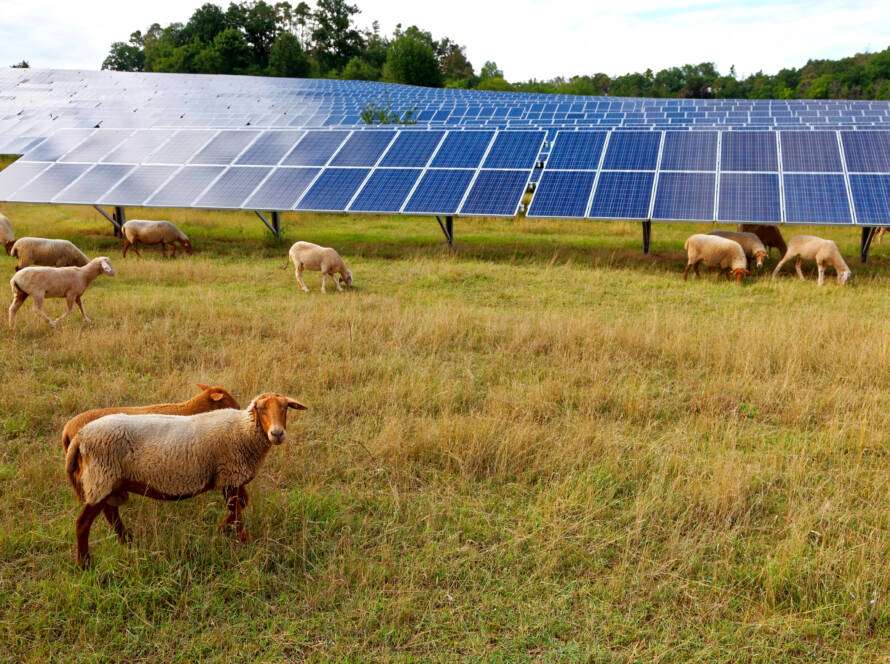
Three tender rounds, one clear double trend: award values for ground-mounted solar are falling from round to round, and the volume of bids submitted is collapsing even faster. Because the Federal Network Agency (BNetzA) sets the tender volume in advance, this is not a demand effect but a supply effect. A growing share of projects simply no longer reaches the competitive range at these prices because of their cost structure. And in the middle of it all is agrivoltaics, which has just achieved its best share of awards so far, while the EEG 2027 is already rewriting the rules for the next round.
Three rounds, one clear trend
The volume-weighted award value has fallen in every round since December 2025: from 5.00 to 4.94 and most recently to 4.79 ct/kWh in July 2026. Over the same period, oversubscription, the ratio of submitted to tendered volume, fell from around 125 % to 101 % and then to 48.5 %. The Federal Network Agency sets the tender volume independently of what happens in the market; it is the fixed quantity in this equation. Oversubscription therefore reflects not demand but supply: how many projects developers can bring to the tender in a competitive state at all. And in absolute terms this supply is shrinking even more markedly than the ratio suggests: the volume submitted fell from 5,247 to 4,622 and then to 3,170 MW. Price and bid volume are therefore falling for the same reason: the award value reflects the actual cost structure of projects, and a growing share can no longer get onto the cost curve at this level and does not bid in the first place.
| Indicator | Dec 2025 | Mar 2026 | Jul 2026 |
|---|---|---|---|
| Tender volume | 2,328 MW | 2,295 MW | 2,134.66 MW |
| Submitted (bids) | 5,247 MW (634) | 4,622 MW (532) | 3,170 MW (401) |
| Oversubscription | ~125 % | ~101 % | 48.5 % |
| Awarded (bids) | 2,341 MW (262) | 2,299 MW (268) | 2,134.66 MW (261) |
| Exclusions | 61 (9.6 %) | 39 (7.3 %) | 48 (11.97 %) |
| Award value (average) | 5.00 ct/kWh | 4.94 ct/kWh | 4.79 ct/kWh |
| Price range | 4.40–5.30 ct/kWh | 3.99–5.10 ct/kWh | 4.38–4.97 ct/kWh |
The upper limit of the bids actually awarded is also falling: from 5.30 to 5.10 and then to 4.97 ct/kWh. The statutory maximum value, which is derived from the three previous rounds, is only lagging behind this development. It has long ceased to be what limits the market; the level of competition does that.
Regional focus in July
| Federal state | Awards | MW | Average MW per award |
|---|---|---|---|
| Bavaria | 75 | 429 | 5.72 |
| Baden-Württemberg | 41 | 266 | 6.49 |
| Rhineland-Palatinate | 25 | 239 | 9.56 |
| North Rhine-Westphalia | 21 | 233 | 11.10 |
| Lower Saxony | 28 | 225 | 8.04 |
Bavaria remains the leader by volume, but with small projects (average 5.72 MW); in North Rhine-Westphalia and Rhineland-Palatinate the sites are on average almost twice as large. Two market logics exist side by side.
Agrivoltaics: record share, and then?
Agrivoltaics does not have its own tender but runs as a “special solar installation” within this first segment, where it competes in a sub-segment that receives preferential awards under Section 37d EEG 2023. Over the three rounds, a remarkable acceleration can be seen:
| Round | Awards | MW | Share of awarded volume |
|---|---|---|---|
| Dec 2025 | 30 | 204 | 8.7 % |
| Mar 2026 | 59 | 439 | 19.1 % (peak) |
| Jul 2026 | no separate figures published | – | – |
The share of special solar installations in the awarded volume more than doubled from December to March. For the July round, the Federal Network Agency has not yet published a separate analysis; anyone who wants to know whether the trend continues will have to wait for the next statistics.
EEG 2027: no dedicated segment any more, but a new uniform bonus
On 29 July 2026, the federal cabinet adopted the EEG amendment and the grid connection package. For agrivoltaics, this confirms the course of the ministry draft of 17 July: the preferentially awarded sub-segment under Section 37d EEG 2023 is abolished, and agrivoltaics will in future compete with conventional ground-mounted systems in the shared first segment. In its place comes a uniform elevation bonus of +0.5 ct/kWh, regardless of whether a system meets the highly elevated category I (at least 2.10 m clearance, passable for farm machinery) or the ground-level, vertically oriented category II (at least 0.80 m) (Section 38a and Section 48(1b) EEG 2027).
| Size class | Legal basis | Value before bonus | + bonus | Result |
|---|---|---|---|---|
| ≤ 1 MW (exempt from tenders) | Section 48(1) EEG 2027 | 6.2 ct/kWh | +0.5 ct/kWh | 6.7 ct/kWh |
| > 1 MW (subject to tenders) | Section 38a in conjunction with Section 37b EEG 2027 | max. 5.9 ct/kWh (maximum value, 1st segment) | +0.5 ct/kWh | max. 6.4 ct/kWh |
Notably, the bonus is the same for category I and category II, even though highly elevated category I systems with a supporting structure and clearance for farm machinery are noticeably more expensive to build than ground-level category II systems. The explanatory memorandum refers to “orientation towards the most cost-effective technology […] in order to avoid over-compensation”; project design itself has to earn the difference in actual substructure costs.
Two further changes feed directly into project planning: if proof of agricultural dual use is missing, the applicable value will in future only fall by 0.5 ct/kWh, and this can be corrected retroactively if the proof is submitted later. A staggered deadline is also new: anyone connecting to the grid later than 18 months after the award loses 0.3 ct/kWh; after 24 months the award lapses entirely (Section 54(1), Section 37e EEG 2027).
New and concrete: location-based steering in grid hot spots
The grid connection package adds an element that becomes directly relevant for site selection: in regions that foreseeably cannot absorb additional wind or solar feed-in, compensation payments for curtailment will no longer apply, capped at a maximum of 20 % of annual generation (18 % in wind priority areas) and limited to six years. Because an award from 1 MW will in future be bound to the land parcel named in the bid, an unfavourable site can no longer be corrected afterwards. Grid compatibility thus becomes an assessment criterion before the bid is submitted, not afterwards. The capped nature, however, makes the risk calculable rather than unlimited.
The parliamentary process in the Bundestag and Bundesrat is still ongoing; entry into force is still planned for 1 January 2027, and changes to detailed rules are common in the process. Ylektra already includes the grid situation in the site analysis of ongoing projects and continues to analyse the parliamentary deliberations and the final version of the support rates.
Conclusion
The real finding of this summer is the new low of 4.79 ct/kWh that agrivoltaics has to compete with. For agrivoltaics, the logic shifts with the EEG 2027: no dedicated, preferentially awarded segment any more, but instead a moderate, uniform bonus, and with location-based steering in grid hot spots a new, readily calculable risk factor that should feed into site selection before bidding, by 2027 at the latest.
FAQ
How large was the agrivoltaics share in the last tender rounds?
Special solar installations reached a share of 8.7 % of the awarded volume in December 2025 (30 awards, 204 MW) and a peak of 19.1 % in March 2026 (59 awards, 439 MW). The Federal Network Agency has not yet published separate figures for July 2026.
What changes for agrivoltaics with the EEG 2027?
The cabinet decision of 29 July 2026 deletes the preferentially awarded sub-segment for special solar installations under Section 37d EEG 2023. Agrivoltaics will in future compete with conventional ground-mounted systems in the shared first segment, but in return receives a uniform elevation bonus of +0.5 ct/kWh (Section 38a and Section 48(1b) EEG 2027), equally for systems up to 1 MW and above.
What is the applicable value for agrivoltaics under the EEG 2027?
For systems up to 1 MW: 6.2 ct/kWh plus 0.5 ct/kWh bonus = 6.7 ct/kWh (Section 48 EEG 2027). For systems over 1 MW that must take part in tenders: a maximum value of 5.9 ct/kWh in the first segment plus 0.5 ct/kWh bonus = a maximum of 6.4 ct/kWh (Section 38a in conjunction with Section 37b EEG 2027).
How do agrivoltaic systems currently take part in the tenders?
From 1 MW, they take part in the first segment as “special solar installations” and are handled there in a separate, preferentially awarded sub-segment under Section 37d EEG 2023.
What is location-based steering in grid hot spots?
In regions that foreseeably cannot absorb additional wind or solar feed-in, compensation for curtailment will no longer apply, capped at a maximum of 20 % of annual generation (18 % in wind priority areas) and limited to six years. Because awards from 1 MW will in future be firmly tied to the named land parcel, grid compatibility should be checked before the bid is submitted.
When does the EEG 2027 enter into force?
Following the cabinet decision of 29 July 2026, the parliamentary process in the Bundestag and Bundesrat is still pending. The rules are to apply from 1 January 2027; changes to detailed rules are possible in the process.