Knowledge · Agrivoltaics
Agrivoltaics: power and harvest on the same land
In short
Agrivoltaics (Agri-PV) uses the same agricultural land for food production and solar power at the same time. In Germany it is defined in DIN SPEC 91434: agriculture remains the main use, and at least 66 % of the usual yield is preserved.
As of October 2026 · Editor: Ylektra GmbH
- ≥ 66 %of the agricultural yield is preserved (DIN SPEC 91434)
- ≤ 10–15 %land loss from the system (category I / II)
- 1,700 GWppotential for elevated agrivoltaics in Germany (Fraunhofer ISE)
- up to 186 %land use efficiency in the Heggelbach trial (Fraunhofer ISE)
Technology
How does agrivoltaics work?
The solar modules are arranged above or between the crops so that cultivation, harvesting and soil management remain possible. That is the key difference from conventional ground-mounted PV, where the land is no longer farmed. DIN SPEC 91434 distinguishes two categories:
Category I
Elevated
Modules with at least 2.10 m clearance; farming takes place underneath, for example in fruit, berry or vegetable growing. At most 10 % land loss.
Category II
Ground-level, between the rows
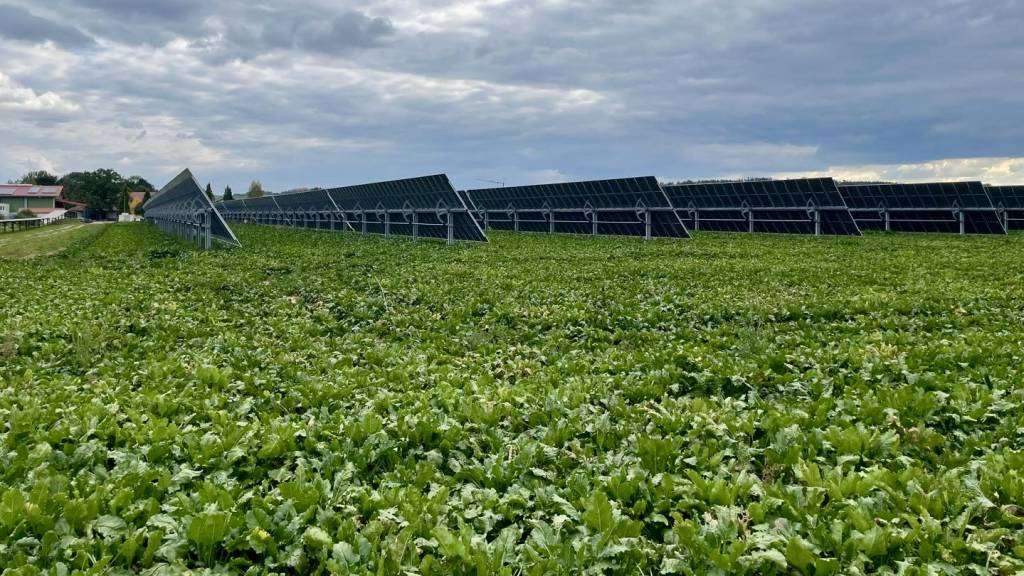
Farming takes place between the module rows, with vertical bifacial modules or single-axis trackers. At most 15 % land loss.
Ylektra builds agrivoltaics with single-axis trackers. The rows follow the sun and can be moved into a convenient position for field work. We set the row spacing according to the working width of the machinery and the crops of the farm.
Economics
Subsidies and remuneration in Germany
As of October 2026
- Until 31 December 2026 (EEG 2023): special solar installations such as agrivoltaics receive a bonus of 0.5 ct/kWh on top of the award value.
- From 2027 (government draft EEG 2027): a bonus of 0.5 ct/kWh for categories I and II; up to 1 MW a fixed value of 6.2 ct/kWh plus bonus, above 1 MW tenders up to 5.9 ct/kWh plus bonus. The law has not yet been passed.
- Agricultural subsidies: agrivoltaic land generally remains eligible for CAP direct payments on 85 % of the area.
An honest assessment
Advantages and disadvantages
Advantages
- Dual use of the same land: food and renewable power.
- Additional, long-term predictable income for farms and landowners.
- Protection from hail, heavy rain and excessive sun; less evaporation and soil erosion.
- Higher public acceptance than conventional solar parks, because farming continues.
Disadvantages
- Higher investment costs than simple ground-mounted PV due to more complex structures.
- Lower capacity per hectare: in Heggelbach around 25 % below conventional solar parks.
- Depending on the crop, yield losses from shading.
- More effort for planning and permitting.
Source for trial results: Fraunhofer ISE, guideline “Agri-Photovoltaik: Chance für Landwirtschaft und Energiewende”, 4th edition, June 2025.
For landowners & farmers
Lease your land for agrivoltaics
Ylektra leases arable land and grassland from 10 hectares across Germany and pays 2,500–5,000 € per hectare and year with a standard term of 30 years, index-linked to the German consumer price index (CPI). We handle planning, financing, construction, operation and decommissioning.
FAQ
Frequently asked questions about agrivoltaics
As of October 2026
What is agrivoltaics (Agri-PV)?
Agrivoltaics (Agri-PV) uses the same land for farming and solar power at the same time. Under the German standard DIN SPEC 91434, agriculture remains the main use and power generation the secondary use. The system may occupy at most 10 % (category I) or 15 % (category II) of the land, and at least 66 % of the usual agricultural yield must be preserved.
What types of agrivoltaic systems are there?
DIN SPEC 91434 distinguishes two categories. Category I: elevated systems with at least 2.10 m clearance, farming takes place underneath the modules, for example in fruit or vegetable growing. Category II: ground-level systems, farming takes place between the rows, for example with vertical bifacial modules or single-axis trackers.
Is agrivoltaics subsidised in Germany?
Until 31 December 2026 the EEG 2023 applies: special solar installations such as agrivoltaics receive a bonus of 0.5 ct/kWh on top of the award value. Under the government draft of the EEG 2027 (cabinet decision of 29 July 2026) a bonus of 0.5 ct/kWh remains for categories I and II; the law has not yet been passed. Agrivoltaic land also generally remains eligible for CAP direct payments on 85 % of the area.
What are the disadvantages of agrivoltaics?
Higher investment costs than simple ground-mounted PV, lower capacity per hectare, possible yield losses from shading depending on the crop, and more effort for planning and permitting. A layout designed around the working width and crops of the farm reduces these drawbacks.
How many agrivoltaic systems are there in Germany?
According to Ylektra's Agri-PV Atlas, the German core energy market data register lists 58 agrivoltaic sites in 9 federal states with a combined 304 MW (as of 15 October 2026). Fraunhofer ISE estimates the technical potential for elevated agrivoltaics alone at around 1,700 GWp.
Can I lease my land for agrivoltaics?
Yes. Ylektra leases arable land and grassland from 10 hectares across Germany and pays 2,500 to 5,000 € per hectare and year with a standard term of 30 years. The lease is index-linked to the German consumer price index (CPI). Ylektra covers planning, financing, construction, operation and decommissioning.
Sources
- Fraunhofer ISE: Agri-Photovoltaik: Chance für Landwirtschaft und Energiewende, 4th edition, June 2025
- DIN SPEC 91434:2021-05, agrivoltaic systems – requirements for primary agricultural use
- German Renewable Energy Sources Act (EEG 2023) and government draft EEG 2027
- Core energy market data register of the Federal Network Agency, evaluated in the Ylektra Agri-PV Atlas